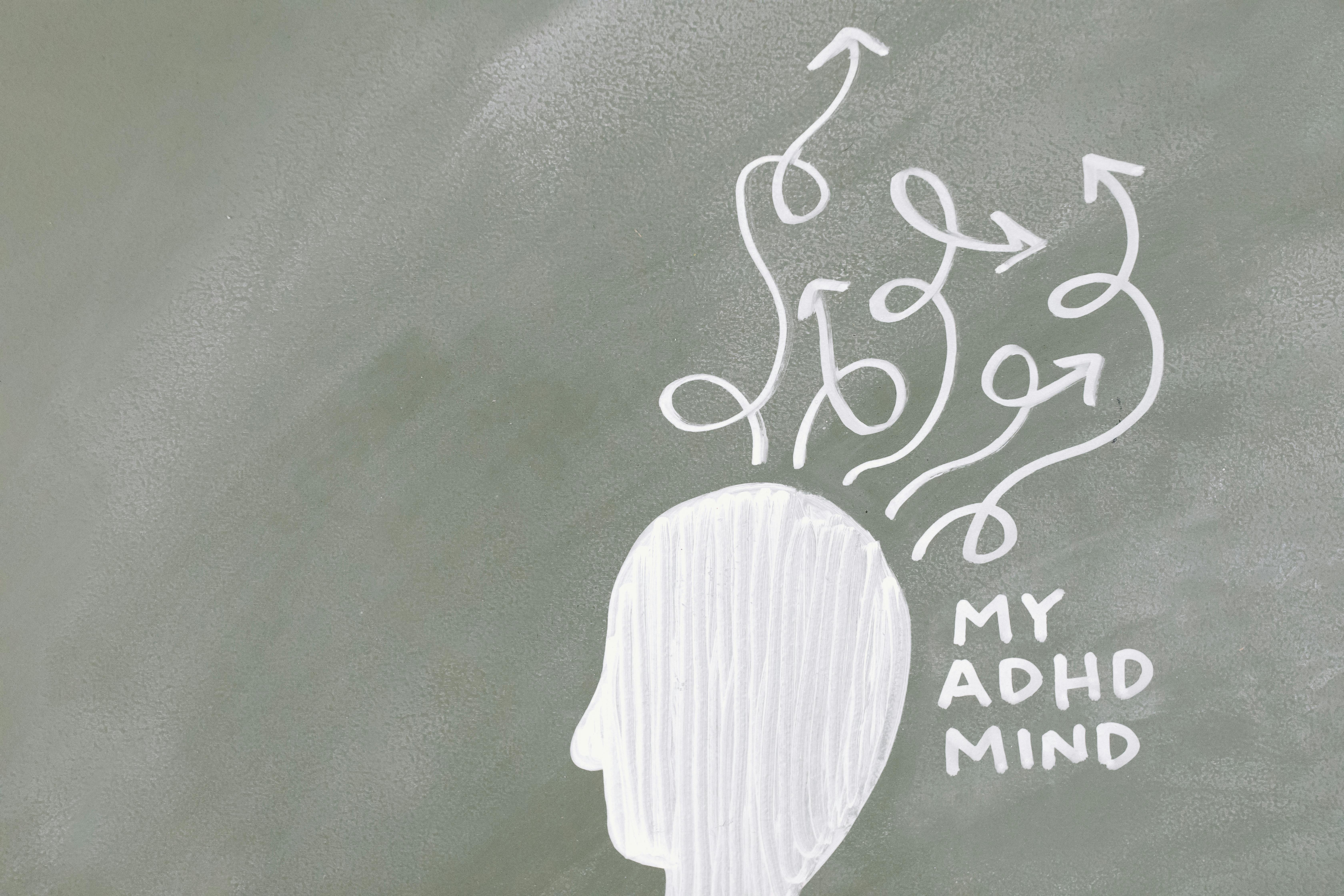
You know exactly what to do. You just cannot make your body do it. This is the core reality of ADHD executive dysfunction: the gap between forming an intention and executing it is not a motivation problem, it is a neurological wiring issue. When your brain plans a task, the striatal circuits that should translate that plan into muscle movement fire inconsistently due to irregular dopamine timing. The result is the ADHD action gap, where you can describe the right strategy in perfect detail and still stare at a blank screen.
Standard advice columns will tell you to break tasks down or use a timer. They assume your brain's intention-to-action pipeline works like a neurotypical brain. It does not. The strategies below do not try to fix your brain. They work with the brain you have, adding external scaffolding at the exact moment your internal circuits fail to fire.
Photo: Tara Winstead / Pexels
Why Does ADHD Make Starting So Hard?
Executive dysfunction in ADHD is not a discipline problem. It is a neurological disconnect between what your brain plans and what your body does. The frontal-striatal circuits that translate intention into action fire inconsistently due to irregular dopamine timing, creating an action gap where you know exactly what to do but cannot make yourself do it. The fix is not more willpower, but external scaffolding that triggers action at the moment of need.
A 2026 study analyzing 277 workplace-related discussion threads from the r/ADHD subreddit Frontiers in Psychology found that contributors consistently described workplace strain not around deadlines or meetings, but around invisible labor and identity-related dynamics. The effort of maintaining a neurotypical presentation while managing ADHD symptoms created a double burden that no productivity app could address.
Russell Barkley and other researchers ADD Resource Center describe ADHD as a performance or intention deficit, where the frontal lobe struggles to translate knowledge into timely action. Task initiation, working memory, and time perception are the three executive functions that tend to fail at exactly the wrong moment.
:::info The ADHD action gap is not about knowing what to do. It is about the neurological gap between deciding and doing. Your brain forms the plan. Your body stays still. :::
Reality Check
"Just start" is the most common piece of advice for ADHD, and it is also the least actionable. If starting were easy, you would already be doing it.
The 7 Strategies That Close the ADHD Action Gap
1. Body First, Brain Later
This is the community's most counterintuitive hack, and it works because it bypasses the prefrontal cortex entirely. Instead of trying to think your way into action, you move your body first and let your brain catch up. Stand up. Walk to the room where the thing lives. Put one hand on the keyboard, the notebook, the dumbbell. You are not committing to the full task, you are just initiating the motion.
Redditors who use this technique report a success rate of about 9 out of 10. The physical act of approaching the task space seems to trigger the brain's action circuits without requiring the motivational buildup that never comes.
2. The Micro-Step Handoff
Instead of telling yourself "write the report," the micro-step is "open the document." Instead of "clean the kitchen," the step is "put one dish in the sink." You are not trying to complete the task, you are just lowering the activation energy threshold below what your brain will accept.
The key is choosing a step so small that it feels almost silly. If your brain can say "no" to it, it is still too big. The handoff happens when your brain agrees to the micro-step and your body starts moving, at which point momentum often carries you forward without further negotiation.
3. Point-of-Performance Cues
Place visual triggers at the exact location where you need to act. A sticky note on your laptop screen that says "START" or a timer placed next to your workout clothes the night before. The cue lives at the point of performance, not in a to-do list app that requires you to remember to check it.
This works because ADHD brains struggle with prospective memory, the ability to remember to do something later. By moving the reminder to the place where the action happens, you eliminate the memory step entirely.
4. Time-Bounded Body Doubling
Use a 25-minute video call with someone who simply sits silently while you work. They do not coach, they do not check in, they just exist in the shared audio-visual space. A 2026 study presented at the ACM CHIWORK symposium CHIWORK 2026 analyzed 3,276 comments from the r/adhd subreddit and found that virtual body doubling was the single most-mentioned focus strategy, with 64 independent mentions.
:::info Body doubling is externalized attention. The presence of another person supplies the activation energy your brain struggles to self-generate. Nothing about the other person needs to be interactive. :::
5. Dopamine-Bridge the Gap
Pair the boring task with a dopamine source. Your favorite playlist, a scented candle, or the mild stimulation of a nicotine patch all add reward signaling to a task that offers none on its own. The goal is not to make the task fun, it is to make it chemically possible to start.
This is why gamification apps work for some people and fail for others. The apps try to inject reward after the fact. The dopamine-bridge approach injects reward before, during, and after, keeping the circuit active throughout the task.
If you have tried strategies like these and keep hitting the same walls, working with a specialist who understands ADHD can make the difference between knowing what to do and actually doing it. The ADHD Care Connect directory lets you filter by location, insurance, and specialization to find the right fit.
Find a Provider6. Externalize the Decision
Use if-then plans. "If it is 9 AM, I will write for 15 minutes." "If my coffee is finished, I will start the next Pomodoro." These are not motivational affirmations, they are conditional triggers that remove the moment-of-choice where your brain can argue against action.
The externalization is the key. You are not relying on your brain to remember to choose the right strategy. You are setting up a rule that fires automatically, like a thermostat that turns on the heat without you deciding whether you are cold.
7. The Task Time Sheet
Track actual time versus estimated time for every task for two weeks. The "just five more minutes" trap compounds when you consistently underestimate how long tasks take. Write down three columns: estimated, actual, and gap. After two weeks, you will see a pattern in the gap, and you can plan accordingly.
Most ADHD brains estimate at about 40 percent of the actual time needed. Once you have data, you can set more realistic expectations and build buffer time that accounts for the action gap rather than pretending it does not exist.
Which Strategy Fits Your Situation?
| If you tend to... | Try this first |
|---|---|
| Feel stuck before you begin anything | Strategy 1: Body First, Brain Later |
| Start strong then fizzle out after 10 minutes | Strategy 4: Time-Bounded Body Doubling |
| Forget what you were doing mid-task | Strategy 3: Point-of-Performance Cues |
| Find boring tasks chemically impossible to start | Strategy 5: Dopamine-Bridge the Gap |
| Overestimate how long things will take | Strategy 7: The Task Time Sheet |
| Know the strategy but forget to use it | Strategy 6: Externalize the Decision |
| Try too many things at once and abandon them | Strategy 2: The Micro-Step Handoff |
How Do You Actually Stick With One Strategy?
The hardest part is not choosing a strategy, it is using it consistently enough to see results. Pick one. Use it for two weeks before adding another. The two-week window is important because your brain needs time to form a new neural pathway, and two weeks is long enough to ride through the initial resistance phase but short enough to maintain momentum.
What to do when you forget for three days in a row? Restart without shame. Do not compound the missed days with guilt, which only widens the action gap. The strategy is not failing you, you are just returning to it. Each re-engagement is a rep that strengthens the pathway.
Warning
Trying multiple strategies simultaneously creates a meta-task of managing the strategies themselves, which becomes the very executive demand you are trying to reduce. One strategy, consistently applied, beats seven strategies rotating weekly.
What Should You Do When Nothing Clicks?
Persistent struggle with executive dysfunction despite tried strategies usually signals an underlying factor that scaffolding alone cannot address. The usual suspects are medication fit, sleep deprivation, untreated anxiety, or the need for professional support in designing systems that match your brain's wiring. Of the directory's active providers, Your Bright Side Counseling Practice is the only one to list executive-function and productivity-systems as structured specializations.
adhd-body-doubling-accountability-strategies dives deeper into body doubling techniques, and adhd-task-initiation-focus-tools covers the tools that help with the first moment of action. For the emotional toll of chronic executive dysfunction, see adhd-burnout-recovery-step-by-step-guide. If procrastination is your main struggle, see adhd-procrastination-strategies-that-work.
Find an ADHD specialist near you, filtering by executive-function specialization and insurance coverage.
Solution
When strategies alone are not enough, the most direct next step is a consultation with a provider who specializes in executive function.
Frequently Asked Questions
What is the ADHD action gap?
The action gap is the disconnect between forming an intention and executing it. In ADHD, the frontal lobe holds the intention but the striatal circuits that should trigger movement fire inconsistently. You can hold a clear plan and still find yourself unable to launch it.
Does ADHD medication help with executive dysfunction?
Medication can reduce the action gap for many people, but it does not eliminate it. Stimulant medications work by elevating dopamine in the striatal pathways, which improves the signal-to-noise ratio for action initiation. However, medication effects vary by task type, timing, and individual neurochemistry, so the action gap often persists even with well-managed medication.
How long before a strategy starts working?
Give any single strategy at least two weeks of consistent use before evaluating it. Your brain needs time to build a new neural association, and two weeks is long enough to move past the initial resistance phase but short enough to maintain momentum.
Can executive dysfunction improve with practice?
Yes, but the improvement comes from external scaffolding, not internal discipline. Each time you use a strategy consistently, you reinforce the neural pathway for that action-context pairing. The goal is to make the strategy automatic, so it fires without requiring the prefrontal cortex to negotiate.
Should I track my progress in a journal?
A simple tracking system helps you see patterns that your memory will miss. The task time sheet (Strategy 7) is a form of tracking that reveals your personal action gap over time. You will see which strategies work for which types of tasks and which situations create the widest gaps.
How to Pick One Strategy and Start Today?
Pick one strategy. Not all of them, not two of them for variety. One. Today.
Start with Strategy 1, Body First, Brain Later. It costs zero dollars, zero setup, and zero belief in its own efficacy. Just stand up and walk to the thing you are avoiding. Touch it. That is the entire strategy. If that feels too hard, touch the thing that is closest to the thing you are avoiding. The motion is the win, not the completion.
Find an ADHD specialist near you, filtering by location, insurance, and specialization.
This article is for informational purposes only and is not a substitute for professional medical advice, diagnosis, or treatment. Always seek the guidance of a qualified healthcare provider with any questions you may have regarding a medical condition.